Fights
Valor Mortis gameplay
Fights are parries, dashes, and visceral finishers, plus guns and three powers.
Open the four weapons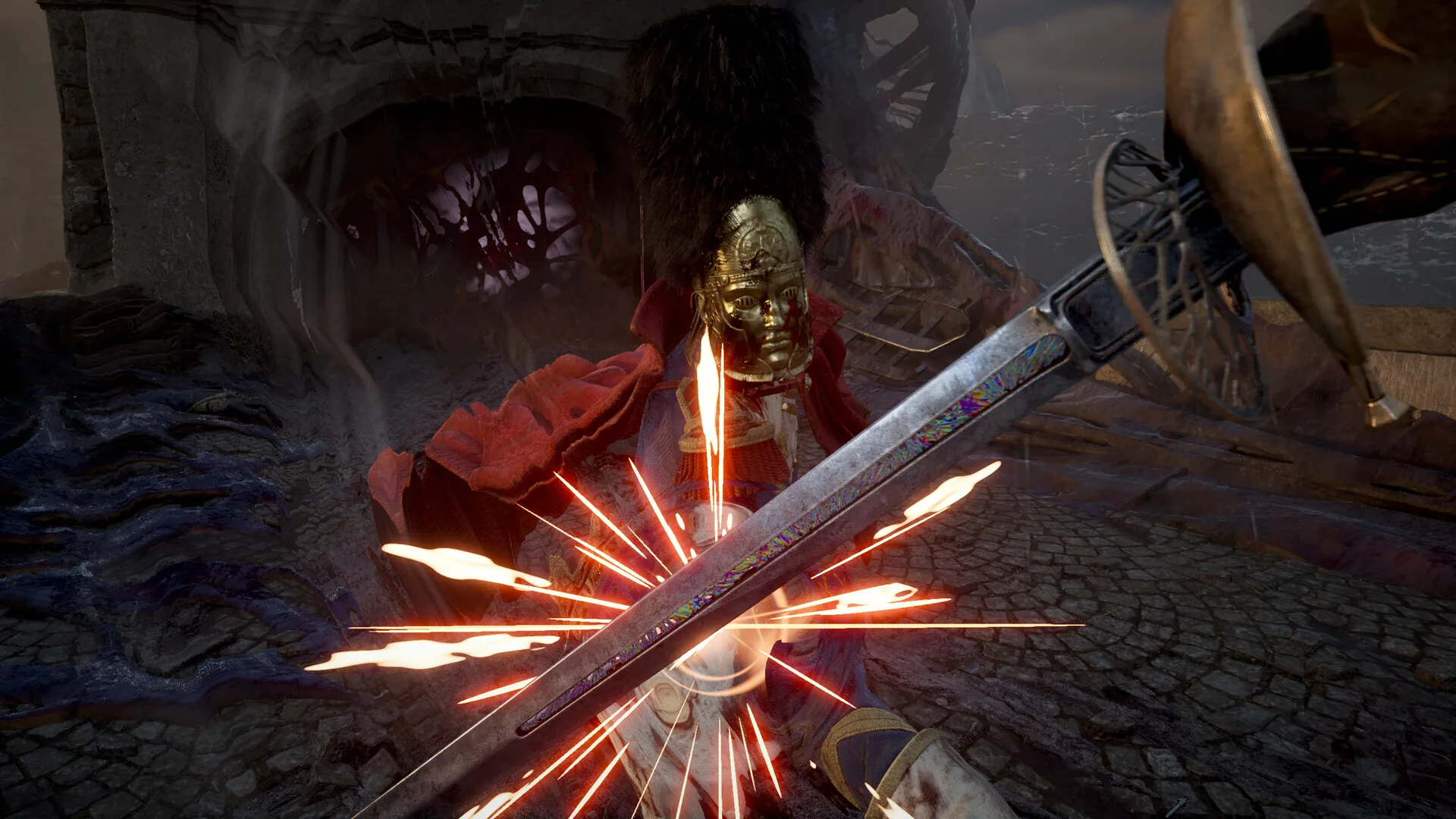
The loop in your hands
Combat is parries, dashes, and visceral finishers across a variety of weapons. Blocking spends a little health, and unblockable attacks are dodged rather than absorbed.
A flintlock pistol sits in that kit, and its ammunition is scarce, so the gun is a punctuating tool, not a primary hose. Light attacks are the quick strikes. Heavy attacks trade speed for a harder hit. On a mouse those are the left and right buttons.
A finisher is the light attack pressed when a broken enemy is on the ground. The payoff is large, which is why the prompt keeps coming back on bosses. Posture is the meter you fill by hitting weak points or by landing timed parries. Break it while you are close enough to take the finisher.
William has three melee options, three guns, and three powers, and each of those has an upgrade tree. Four weapons are named so far: Rapier, Saber, Musket, and Pistol. Two names from that six-weapon count are still unpublished.
One flame upgrade explodes burning enemies when they are shot. One saber upgrade restores stamina after a dodge attack. Those two are examples from the trees, not the whole grid.
Resources you actually spend
Transmutations are the left-hand powers. That is Lyrical Games' name for them. They spend Nephtoglobin. Nephtoglobin is the purple bar under health. You refill it by breaking weak points or by hitting with the sword.
The Rapier is fast at destroying those weak spots, which is why it pairs with a power: the bar comes back while you stay in melee. The Pistol is the smaller firearm aimed at the same weak spots. The Musket is the long single-target gun. Neither replaces the parry.
Ambers change how William plays. One heals on an execution after a posture break. Another, named Perfectionism, adds substantial damage at full health. You do not equip those from a camp menu in the field. You rest at a lantern, spend Catalysts, and the first Amber slot opens at level 5.
Catalysts are also the stat currency. They upgrade stats, stamina, and health. Unspent ones drop when you die. A fight plan is: keep a little Nephtoglobin for the left hand, spend Catalysts only at the lantern, and save a finisher for the posture break.
The pressure is the soulslike framing, the health cost of blocks, and scarce pistol ammo. The weapons page has the named steel. The powers page covers how a Transmutation is taken from a plague-infected figure.
- Parry what can be parried. Dodge what is unblockable.
- Break a weak spot to refill the purple bar, then spend it on the left hand.
- Stand close when posture breaks so the light-attack finisher connects.
- Treat pistol shots as scarce. Use them on weak spots, not on every grunt.
What the hands actually do
On a mouse the light strike is the left button and the heavy strike is the right. The heavy strike is the slower one. A backstab is the light attack from behind an unaware soldier, and the stab plays on its own.
A block does not erase the hit. It spends endurance and still lets a portion of health through. A melee hit landed immediately afterward earns that health back. The Saber is the named weapon with that refund.
Attacks wrapped in a red aura are the unblockable ones. Dodge them. A perfect dodge, timed in the instant before contact, gives a few safe frames and strengthens the swing that follows.
Posture is a yellow bar under the enemy health bar, and bosses carry one too. A successful parry fills it faster than ordinary cuts. When the bar is full, the critical finisher is the light attack while the target is down. Be in reach or the prompt is wasted.
A pistol can sit in the left hand with a sword in the right. A Transmutation wants that same left hand empty, so the sidearm and a power do not share the slot. Bayonets are another weapon that spends ammunition, and they are not one of the four named weapons.