Rapier
- Role
- melee
- Reach
- close
- Trait
- Fast. Destroys Nephtoglobin weak spots. Parry is stronger. Cannot block properly.
Armory
Four weapons are named: Rapier, Saber, Musket, and Pistol.
Start with the Saber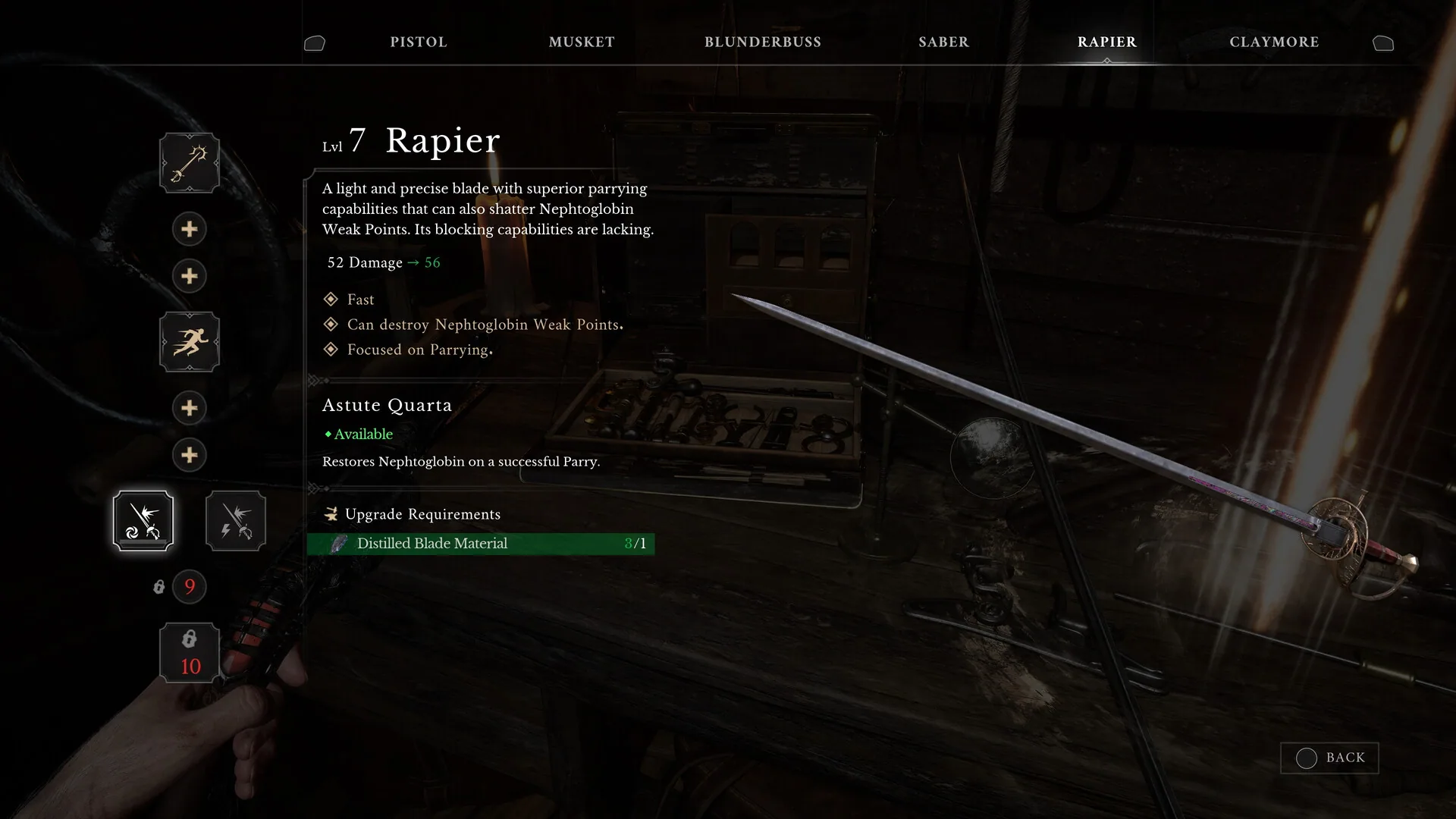
4 researched weapons. 4 shown.
No weapons match these filters.
Use the Rapier up close when you need weak spots broken and can live without a real block.
The Rapier is a close melee weapon. It is fast, and it is built around Nephtoglobin weak spots. Its parry is the stronger sword parry of the named blades. The cost is explicit: it cannot block properly.
Bring it when the enemy's punish is a parryable swing, not a chain you needed to eat with a block. The Saber is the other close melee weapon and the alpha starter. That is the weapon that blocks, reduces the hit, and refunds the health if you strike back.
If you are still learning timings, start on the Saber. Move to the Rapier when you trust the parry and you are starving the purple bar. The Rapier was in the Alpha Demo Build with the Musket and the Pistol. It is not the starter.
Open on a weak spot. Its job is to destroy those spots, and breaking them refills Nephtoglobin for the left hand. Transmutations spend that bar. A fast spot-breaker is how you cast without abandoning melee, which is the whole point of the off-hand design.
When a swing is parryable, take the stronger parry. When an attack is unblockable, dodge it. This sword will not save you with a block. Stay close for the finisher. Posture breaks want you near the body so the light attack lands while the target is down.
The Pistol covers the same weak spots at short range and is smaller than the Musket. Use it when a spot is awkward for the blade, then return to the Rapier so the bar keeps moving. The Musket is the long single-target gun. It does not share the Rapier's job. Swap to it only for a distant shooter, not for the spot in front of your face.
On Lothaire, weak points sit on the chest, near the belly, and behind the right leg. A fast blade can tour those three if you survive the flagpole. His pistol arms are his, not yours. Dodge the three spaced shots. Do not try to block them with this sword.
Aurelius in the first stage is a human-stature duel with one sword and very fast swings. A stronger parry fits that duel if you have the timing. If you do not, the Saber's block is the safer named option. The Sphinx pounces and then uses claws and a tail. Close reach means you are in the pounce's landing. Sidestep first, then take the spots you can reach.
Three melee options exist, and this is one of the two named blades. The third melee name is still unpublished, so it does not sit next to the Rapier. Upgrade trees exist for those weapons. Use the tree you see in game, and keep the weapon's identity: fast, spots, stronger parry, no real block.
The Rapier feeds Transmutations because it breaks Nephtoglobin points quickly. You stay in melee, the purple bar returns, and the left hand has a resource to spend. A pistol in that left hand occupies the power slot, so the sword-and-power pair is the one you choose when you want to cast.
Red-aura attacks still require a dodge. This blade will not block them. A perfect dodge, timed just before the hit, strengthens the next poke, and that poke belongs on a weak spot.
Against ordinary soldiers a backstab is the light attack from behind an unaware target. Bosses are not unaware. On Lothaire the useful targets are the orange points on the chest, near the belly, and behind the right leg. Tour those with the fast blade if you have already sidestepped the dive.
Aurelius in phase one is a human-sized swordsman who also fires a pistol now and then. The stronger parry fits the sword strings if your timing is already honest. If it is not, this is the wrong sword for soaking a miss. The Sphinx opens distance and then pounces. Sidestep the landing before you hunt a spot with the point.
| Line | On the card |
|---|---|
| Role | Close melee |
| Reach | Close |
| Parry | The stronger parry of the two swords |
| Block | Will not soak a hit |
| Demo | Alpha Demo Build, not the starter |
Keep the Saber out while you learn blocks. It is the named starter.
The Saber is the close melee starter from the Alpha Demo Build. The heading spells Saber. The body spells Sabre. Both names are this weapon. It parries and it blocks. That second verb is the split from the Rapier, which cannot block properly and instead offers the stronger parry.
A block on this weapon reduces the incoming damage. If you land a melee hit quickly afterward, you recover the health the block spent. Blocking in general spends a little health. The Saber is the named weapon where a follow-up hit gives that spend back.
Do not treat every weapon as if it had the refund. The Rapier does not have it. The guns do not have it. A saber upgrade restores stamina after a dodge attack. That is a tree node on top of the base weapon, not the block refund rewritten.
Use it for the first hours, and whenever a boss mixes parryable swings with hits you would rather soak than dodge. Lothaire's flagpole is three advancing swings, and those swings are parryable. A starter that can also block is a fair answer if a parry misses.
His dive is the exception, and it is unblockable. Sidestep it. Blocking is the wrong answer for that move. Aurelius opens as a fast one-sword duel at human stature in Chapter 7. Little wind-up means late blocks. This is still the sword that forgives a block better than the Rapier.
The Sphinx pounce is a gap-closer. A block may blunt the landing if you are late on the sidestep, then the refund wants an immediate hit, not a reload. Pair the Saber with a gun only as the secondary. The Musket picks a single far target. The Pistol breaks weak spots the blade is slow to tour.
Nephtoglobin still refills from sword hits and from shattered spots. This starter can feed Transmutations, just less surgically than the Rapier. On Lothaire, Fire Transmutation is highly effective. The Saber can stay in the right hand while that power spends the purple bar.
Ambers do not replace the block. Perfectionism wants you unhurt, which is an argument for blocking less and parrying more even on the weapon that can block. A heal when you execute after a posture break wants the finisher. Be close when the meter pops, same as with any other melee weapon.
Level 5 is the first Amber slot, spent at a lantern. Until then the Saber and a power, if you have been given one, are the whole kit. Filter to melee and close and this weapon and the Rapier are the two rows. Sort by name if you want Rapier first.
A block spends endurance and still lets some health through. On the Saber, a quick melee hit gives that health back. The refund is health, not stamina. The stamina return after a dodge attack is a separate saber upgrade.
A red aura marks a swing this sword cannot block. Dodge that swing even though this is the blocking starter. A perfect dodge strengthens the following hit, which is a clean moment to take a punish if you are already in range.
Keep the left hand empty when you want a power. The Saber stays in the right hand for that build. Putting the pistol in the left hand is the other build, and it is the build that gives up the off-hand spell.
Lothaire's two-hit flagpole slash and his three-step flagpole swing are both parryable. His dive and his second-stage arm swing are not. Use the block on the parryable pole, and dodge the unblockable moves. Aurelius can be blocked in phase one. His phase-two leap is unblockable, so the refund habit has to wait until he lands.
| Line | On the card |
|---|---|
| Role | Close melee starter |
| Reach | Close |
| Parry | Yes, and it can block |
| Refund | A quick hit returns health the block spent |
| Spelling | Heading Saber, body Sabre |
Bring the Musket for one distant target. It is the long gun, not the sidearm.
The Musket is a firearm with long reach. It is a long-range gun for single targets. It was in the Alpha Demo Build with the Rapier and the Pistol. It is not the starter. The Saber is.
The Pistol is the short sidearm and is smaller. Use the Musket when the target is far and alone. Use the Pistol when the spot is close and the Musket is clumsy. Ammunition is scarce, the same pressure as the flintlock. Both guns live under that limit. The Musket's single-target focus is how you avoid wasting a shot on a crowd.
You can hold a primary and a secondary. A sword in one slot and the Musket in the other matches the split between melee primaries and ammunition weapons. Bayonets are another ammunition weapon and are not a named row.
Nephtoglobin refills from weak spots and from sword hits, not from standing at musket range. After the shot, close in or the purple bar stays empty. The Rapier is the melee piece that farms those spots fastest. A Musket opener into a Rapier follow-up is a coherent pair: one far target, then the spots.
The Saber is the safer melee half if you still want a block after you close. The Musket does not parry for you. A flame upgrade explodes burning enemies when they are shot. That is the tree example most relevant to a gun, and it is not exclusive to the Musket.
Three guns exist and two are named. Do not label a third firearm as a Musket variant. Its name is still unpublished. Lothaire fires three pistol shots from shoulder arms. A long gun can answer him before you enter the flagpole's reach, about three sword-lengths.
Once you are inside that reach, the Musket is the wrong tempo. The flagpole is parryable on the Saber or the Rapier. Swap. In his second stage the enlarged arm can be shot to fill posture. That is a Musket job if you have the round, then a finisher job up close.
The Sphinx pounce deletes long range. If you open with the Musket, assume one shot before the body is on you. Aurelius fights as a duelist at human size with one sword. Long range is a brief luxury in a room that small. Do not build the whole attempt on this gun.
Ambers such as Perfectionism care about your health, not about which barrel you used. Socket them at a lantern from level 5. Filter the index to firearm and long if you want this row alone. Short plus firearm is the Pistol.
Scarce ammunition makes the single-target rule an ammo rule as well. Choose the distant shooter, fire once, and close. Standing at musket range does not rebuild Nephtoglobin. Sword hits and broken spots do.
Bayonets are the other ammunition weapon. They are not a fitting for this gun, and they are not a row beside it.
The Deluxe skin pack places a musket beside a blunderbuss and a claymore. Those extra names are cosmetics on the edition. They do not add a firearm row here, and they do not change the job of a long single-target shot.
Lothaire can throw a corpse. A long gun can hit that corpse before it arrives, which is a better use of a scarce round than firing into his pistol-arms while you are still outside the pole. Once the pole is swinging, swap to a sword. The Musket does not parry the three-step swing or the two-hit slash.
The Sphinx likes to be the one that closes. Treat the Musket as the opening round, then assume claws. Aurelius fights inside a village room. A long barrel is a punctuation between his sword strings, not the weapon that carries phase two when the free hand becomes a claw.
| Line | On the card |
|---|---|
| Role | Firearm |
| Reach | Long |
| Job | One distant target |
| Ammo | Scarce, same economy as the flintlock |
| Demo | Alpha Demo Build, not the starter sword |
Use the Pistol on weak spots up close. It is the small gun.
The Pistol is a firearm with short reach. It is a sidearm for Nephtoglobin weak spots, and it is smaller than the Musket. It was in the Alpha Demo Build, and it is not the starter. The starter sword is the Saber.
Scarce ammunition, the flintlock's limit, is the economy for this slot. Every shot should be a weak spot you cannot comfortably take with the blade. The Rapier destroys those same spots in melee and has the stronger parry. The Pistol is the shot you fire when the spot is exposed for a moment and the blade is recovering.
The Musket is the long single-target weapon. If the enemy is across the battlefield, that is the Musket's job, not this one. Both can sit as the secondary beside a sword. A primary and a secondary equip together, and pistols are ammunition weapons.
Break a spot, watch the purple bar, and decide whether the left hand earns the Nephtoglobin. Transmutations spend it. Sword hits and further spots put it back. If the bar is full and the spot is in blade range, the Rapier may be the better spend. If the bar is empty and the spot is flashing, the Pistol is the interrupt.
Lothaire's own extra arms fire pistols, three spaced shots. That is his attack, not a prompt to trade magazines. Dodge sideways. Your sidearm is for his weak points: chest, belly, and behind the right leg. Shooting his enlarged arm in the second stage fills posture. A short gun can do that if you are already in the room and do not want to swap to the Musket.
Aurelius's first stage is a fast sword duel. A sidearm is a puncture between his swings, not a plan to outrange a man who is already on you. The Sphinx closes with a pounce. Short reach means you are firing as it arrives, not while it is a speck. Sidestep the landing, then shoot a spot if the blade cannot.
Do not block with a pistol. Blocks belong to the Saber. Parries on the named swords are the defensive tech. The gun is the puncture. Scarce ammo means you still walk most of the level with the sword out. The Pistol does not clear a room.
Three guns exist and two are named. Leave the third unnamed. A flame upgrade that explodes burning targets when they are shot is the gun-side example. It applies when you have that node, including on this sidearm if the tree offers it.
Ambers do not reload you. Perfectionism adds damage at full health, which is a reason to stop trading, not a reason to empty the pistol. On the index, filter firearm and short to isolate this row. Close is the swords. Long is the Musket.
This sidearm can sit in the left hand with a sword in the right. That pair is real. It is also the pair that fills the hand a Transmutation needs. If you are casting, the sidearm comes off that hand.
Spend a scarce round on a weak spot the blade is late to reach. The Rapier breaks the same spots without ammo. Fire when the spot is open, then return to the sword so the purple bar keeps climbing.
Lothaire rips a corpse off his body and throws it. Shooting that corpse is a sidearm job. At the distance where the corpse is already beside you, this is the gun you can fire without the Musket's length. His own three pistol shots are still his attack. Sidestep them. Do not trade magazines.
Once the Sphinx is moving, a pistol beats a blunderbuss, because the sidearm holds more rounds while the beast dashes, jumps, and chains hits. Open with the harder gun only if you actually have it. Otherwise the Pistol is the firearm half of that plan.
Aurelius pulls a pistol during the sword duel. Blocking or parrying that shot is a saber job. Your own sidearm is the puncture you take when his pattern ends, not a plan to outshoot a man who is already in sword range.
| Line | On the card |
|---|---|
| Role | Firearm sidearm |
| Reach | Short |
| Job | Weak spots the blade is late to reach |
| Size | Smaller than the musket |
| Hand | Left-hand slot, or leave it free to cast |
There are three melee options and three guns. Four are named: two melee, Rapier and Saber, and two firearms, Musket and Pistol. Two names from that count are still unpublished. Filter by the weapons that are named.
Role is melee or firearm. Reach is close, short, or long. Pistol is the short firearm. Musket is the long one. Both swords are close. Filter by role and reach, or sort by name, role, or reach. The count above the list is how many weapons survive the filter.
A primary and a secondary can be equipped together. Swords are the usual primary. Pistols and bayonets are ammunition weapons. A bayonet needs ammunition and is not a fifth named row.
Rapier, Musket, and Pistol were in the Alpha Demo Build. The Saber was the demo starter. The heading spells Saber and the body spells Sabre. Both names are this weapon.
Use the Saber when you want a block and a parry on the same starter. A block reduces the hit, and a quick melee reply is how the Saber gives the spent health back. Use the Rapier when the target has Nephtoglobin weak spots and you can afford to skip a real block. Its parry is the stronger of the two sword lines.
Use the Musket when one distant target needs to die and you have the ammunition. It is not the crowd tool. Use the Pistol as the sidearm for those same weak spots when the Musket is too slow or too large for the room.
The flintlock's scarce ammunition is the pressure on both guns. Count shots. Spend them on spots the sword is bad at reaching, or on spots the Rapier is already built to break if you need the purple bar. Nephtoglobin, the purple bar, refills when weak spots shatter or when the sword connects. A Rapier route keeps Transmutations fed. A Musket route must walk back into melee to recover the bar.
Upgrade trees exist. One flame node explodes burning enemies on a shot, and one saber node returns stamina after a dodge attack. Those are examples, not the whole grid. Ambers are not weapons. Socket them at a lantern from level 5. A heal on execution and Perfectionism change the fight without changing which weapon is in your hand.
Reach matters on the bosses. Lothaire shoots from extra arms and swings a flagpole. A long Musket can answer a distant tell. The Sphinx closes with a pounce, which punishes a gun that needs the target to stay far. Once the pole or the pounce is on you, the Saber or the Rapier has to take over.
You can equip a primary and a secondary at the same time. Melee swords are the usual primary. Pistols and bayonets sit on the ammunition side, and both need rounds. A bayonet is a named ammunition weapon and still is not a fifth row.
Three melee options and three guns exist. The named rows are Rapier, Saber, Musket, and Pistol. Claymore and blunderbuss appear inside the Deluxe La Grande Armee skin pack, next to rapier, sabre, musket, and pistol. A skin name is not a fifth weapon. Filter by melee or firearm until the row you want is the one that opens.